


# kportal
kportal runs many Kubernetes port-forwards from one YAML file and shows their status in a terminal UI. It reconnects dropped forwards, reloads the file when it changes, and can run without the UI.
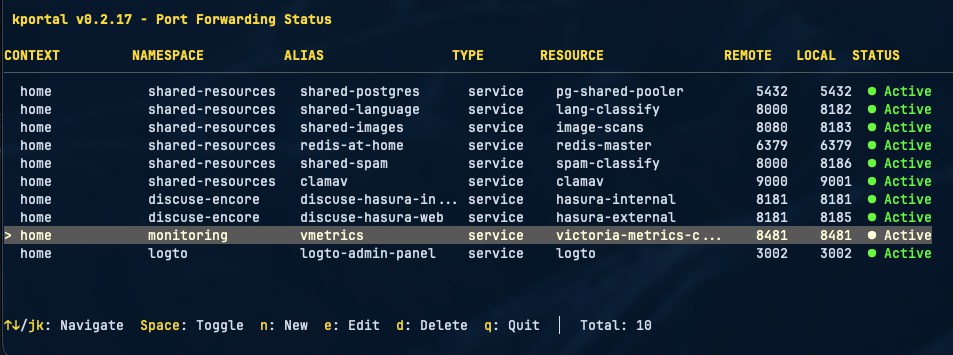
Screenshot from kportal v0.2.17. The current key bar also lists `PgUp`/`PgDn`, `b` (Bench) and `l` (Logs).
Website:
## Contents
- [Features](#features)
- [Comparison](#comparison-with-other-tools)
- [Installation](#installation)
- [Quick start](#quick-start)
- [Configuration](#configuration)
- [Usage](#usage)
- [Status indicators](#status-indicators)
- [Advanced features](#advanced-features)
- [Migration from kftray](#migration-from-kftray)
- [Signal handling](#signal-handling)
- [Troubleshooting](#troubleshooting)
- [Development](#development)
- [Telemetry](#telemetry)
- [License](#license)
## Features
| Area | What kportal does |
|------|-------------------|
| Forwards | Forwards to `service/`, `pod/` (exact name or name prefix), or `pod` with a label `selector`. Only TCP is supported. |
| Terminal UI | Add (`n`), edit (`e`), delete (`d`) and toggle (`Space`) forwards without a restart. The add wizard writes the config file. |
| Table columns | `tui.columns` sets which columns the forwards table shows, their order and their width. It applies to the UI and to the `-v` table. |
| Add wizard | If the cluster does not allow listing namespaces, the wizard asks you to type the namespace. |
| Reconnect | Retries with exponential backoff: 1s, 2s, 4s, 8s, then 10s, with 10% jitter. It does not stop retrying. |
| Pod restarts | Forwards by pod prefix or selector connect to a new pod after a restart. |
| Health checks | `tcp-dial` or `data-transfer` check every 3s by default. A connection is stale when it is older than `maxConnectionAge` and idle, or idle longer than `maxIdleTime`. |
| Hot reload | The file watcher and `SIGHUP` reload the config. An invalid config is rejected and the previous one stays active. |
| Contexts | Several Kubernetes contexts and namespaces in one file. `--context` selects which contexts run. |
| Port conflicts | Startup and reload checks report a busy local port and the process that holds it. |
| mDNS | With `mdns.enabled: true`, each forward is reachable as `.local`. Without an alias, the resource name is used. |
| HTTP log | Per-forward request and response log in the UI, with detail view, filter, search, JSON formatting, gzip/deflate decoding and clipboard copy. |
| Header redaction | With `includeHeaders: true`, values of sensitive headers such as `Authorization` and `Cookie` become `[REDACTED]`. You cannot turn this off. |
| Benchmark | Press `b` to send HTTP requests through a forward. Reports success and failure counts, min/max/avg latency, P50/P95/P99, requests per second and status codes. |
| Generate | `kportal generate` lists services in a cluster and appends the ones you pick to the config with consecutive local ports. |
| Headless | `-headless` runs without the UI and logs to stderr. `-log-format json` switches the log format. |
| Import | `-convert` turns a kftray JSON file into a kportal YAML file. |
| Shell completion | `kportal completion` prints a bash, zsh or fish completion script, or installs it. |
| Verified installer | `install.sh` checks the archive SHA-256 and, if `cosign` is on `PATH`, the keyless signature of the checksums file. |
| Updates | `-update` checks for a newer release. `-version` prints the version. |
## Comparison with other tools
Compared on 2026-10-02 against each project's README and docs. Check their repositories for changes. The kportal column comes from this repository's code. "Not documented" means the project's README and docs do not say.
| Feature | kportal | kubectl port-forward | k9s | kubefwd | kftray |
|---------|---------|----------------------|-----|---------|--------|
| Many forwards in one config file | Yes | No | Partial (annotations configure forwards; no forward list file) | Partial (`example.fwdconf.yml` exists) | Yes |
| Automatic reconnect | Yes | Not documented | Not documented | Yes | Yes |
| Follows pod restarts by label or name prefix | Yes | Not documented | Not documented | Yes (label filter) | Yes |
| Terminal UI of all forwards | Yes | No | Yes (PortForward view, alias `pf`; forwards last for the session) | Yes | Yes |
| GUI | No | No | No | No | Yes |
| Config hot reload | Yes (file watcher, `SIGHUP`) | No | Partial (`benchmarks.yaml` only) | Not documented | Not documented |
| HTTP request and response logging | Yes | No | Not documented | Not documented | Yes |
| Health checks | Yes (`tcp-dial`, `data-transfer`) | Not documented | Not documented | Not documented | Partial (README says it tracks pod health) |
| mDNS or friendly hostnames | Yes (mDNS) | No | No | Partial (edits `/etc/hosts`, not mDNS; needs root) | Not documented |
| Built-in benchmark | Yes | No | Yes (`hey`, key `b`) | Not documented | Not documented |
| Imports another tool's config | Yes (kftray JSON) | No | No | Not documented | Partial (JSON, GitHub repos, service annotations; not other tools' formats) |
| Several contexts in one config | Yes | No | Partial | Partial | Not documented |
| Local port conflict detection | Yes (reports the holding process) | Partial (`:remotePort` picks a free port) | Not documented | Yes | Not documented |
| Platforms | Linux, macOS, Windows | Not documented | macOS, Linux, Windows | macOS, Linux, Windows | macOS, Linux, Windows |
| Licence | MIT | Not documented | Apache-2.0 | Apache-2.0 | GPL-3.0 |
| Language | Go | Not documented | Go | Go | Rust (Tauri, Ratatui) |
| Latest release (2026-10-02) | [Releases](https://github.com/lukaszraczylo/kportal/releases) | Not documented | v0.51.0 (2026-06-06) | v1.25.16 (2026-06-20) | v0.29.2 (2026-09-29) |
When another tool fits better:
- kubectl port-forward for a one-off forward. It needs no config file and ships with kubectl.
- k9s for general cluster browsing and its built-in benchmark.
- kubefwd to forward every service in a namespace with local DNS names.
- kftray for a tray GUI, shared JSON configs and UDP.
Kube Forwarder is a GUI-only forwarder. Its last release was 2019-08-14.
Sources:
- kubectl: [Use Port Forwarding to Access Applications in a Cluster](https://kubernetes.io/docs/tasks/access-application-cluster/port-forward-access-application-cluster/)
- k9s: and
- kubefwd:
- kftray:
## Installation
### Homebrew (macOS)
```bash
brew install --cask lukaszraczylo/taps/kportal
```
If you installed the formula (`brew install lukaszraczylo/taps/kportal`) earlier, run `brew uninstall kportal` first.
### Quick install
```bash
curl -fsSL https://raw.githubusercontent.com/lukaszraczylo/kportal/main/install.sh | bash
```
The script downloads `kportal--checksums.txt` from the same release and verifies the archive SHA-256. If [`cosign`](https://github.com/sigstore/cosign) is on `PATH`, it also verifies the keyless signature of the checksums file.
| Variable | Effect |
|----------|--------|
| `DRY_RUN=1` | Download and verify only. Do not install. |
| `SKIP_COSIGN=1` | Skip the cosign check. The SHA-256 check still runs. |
| `INSTALL_DIR` | Target directory. Default `/usr/local/bin`. |
| `KPORTAL_VERSION` | Install a specific version, for example `1.2.3`, instead of the latest. |
| `COSIGN_CERT_IDENTITY_REGEXP` | Certificate identity to accept. Set it if you fork the release pipeline. |
Example:
```bash
curl -fsSL https://raw.githubusercontent.com/lukaszraczylo/kportal/main/install.sh | DRY_RUN=1 bash
```
### Manual download
The [releases page](https://github.com/lukaszraczylo/kportal/releases) has archives for Linux, macOS and Windows on amd64 and arm64. Archives are named `kportal---.tar.gz`, and `.zip` on Windows. Each release also has a `kportal--checksums.txt` file.
### Build from source
Go 1.26 or later is required (see `go.mod`).
```bash
git clone https://github.com/lukaszraczylo/kportal.git
cd kportal
make build && make install
```
`make install` copies the binary to `/opt/homebrew/bin` if that directory exists, otherwise to `~/.local/bin` on macOS and Linux.
### Verifying release signatures
Release checksums are signed with [cosign](https://github.com/sigstore/cosign) using keyless signing. Download the checksums file and its sigstore bundle from the release, then run:
```bash
cosign verify-blob \
--certificate-identity-regexp "^https://github\.com/lukaszraczylo/shared-actions/\.github/workflows/go-release\.yaml@refs/heads/main$" \
--certificate-oidc-issuer "https://token.actions.githubusercontent.com" \
--bundle "kportal--checksums.txt.sigstore.json" \
kportal--checksums.txt
```
Replace `` with the release version, for example `1.2.3`. Then check the archive against the verified checksums file with `shasum -a 256` or `sha256sum`.
## Quick start
Create `.kportal.yaml`:
```yaml
contexts:
- name: production
namespaces:
- name: backend
forwards:
- resource: service/postgres
protocol: tcp
port: 5432
localPort: 5432
alias: prod-db
- resource: service/api
protocol: tcp
port: 8080
localPort: 8080
alias: api
httpLog: true
```
Each `name` under `contexts` must exist in your kubeconfig. List them with `kubectl config get-contexts`.
Run:
```bash
kportal
```
### Keyboard controls
Forwards list:
| Key | Action |
|-----|--------|
| `Up` `Down` / `j` `k` | Move the selection |
| `PgUp` `PgDn` / `Ctrl+u` `Ctrl+d` | Move by 10 rows |
| `Space` / `Enter` | Toggle the forward |
| `n` | Add a forward |
| `e` | Edit the forward |
| `d` | Delete the forward (asks to confirm) |
| `b` | Benchmark the forward |
| `l` | Open the HTTP log |
| `q` / `Ctrl+c` | Quit |
In the add and edit wizard, `h` on the confirmation step toggles `httpLog`. Advanced `httpLog` keys you set in YAML stay unchanged.
HTTP log keys are listed under [HTTP traffic logging](#http-traffic-logging).
## Configuration
### Basic structure
```yaml
contexts:
- name:
namespaces:
- name:
forwards:
- resource: /
protocol: tcp
port:
localPort:
alias: # optional
selector: # optional
httpLog: true # optional
```
### Forward options
| Field | Required | Description |
|-------|----------|-------------|
| `resource` | Yes | `service/`, `pod/`, or `pod` with `selector` |
| `protocol` | No | `tcp`. No other value is accepted. |
| `port` | Yes | Remote port |
| `localPort` | Yes | Local port |
| `alias` | No | Display name and mDNS hostname |
| `selector` | With bare `pod` | Label selector. Not allowed with `pod/`. |
| `httpLog` | No | `true`, or a map of options (see [HTTP traffic logging](#http-traffic-logging)) |
### Resource formats
| Format | Description |
|--------|-------------|
| `service/name` | Forward to a service |
| `pod/name` | Forward to a pod by exact name, or by name prefix |
| `pod` with `selector` | Forward to a pod picked by label selector |
Valid resource types are `pod` and `service`. To reach a deployment, use `pod` with a `selector`.
### Health checks and reliability
```yaml
healthCheck:
interval: "3s"
timeout: "2s"
method: "data-transfer" # or tcp-dial
maxConnectionAge: "25m"
maxIdleTime: "10m"
reliability:
tcpKeepalive: "30s"
dialTimeout: "30s"
retryOnStale: true
watchdogPeriod: "30s"
```
The values above are the defaults from `.kportal.yaml`.
- `tcp-dial` opens a TCP connection to the local port.
- `data-transfer` also tries to read data through the tunnel. It is the default.
- A connection past `maxConnectionAge` reconnects only when it is also idle, so a running transfer is not cut.
- `watchdogPeriod` is the interval of the check for hung workers.
### mDNS
```yaml
mdns:
enabled: true
contexts:
- name: production
namespaces:
- name: default
forwards:
- resource: service/postgres
port: 5432
localPort: 5432
alias: prod-db # reachable as prod-db.local:5432
```
- `alias: prod-db` publishes `prod-db.local`.
- Without an alias, `service/redis` publishes `redis.local`.
- A bare `pod` with a selector and no alias is not published.
- Services register as `_kportal._tcp`.
Check registration:
```bash
dns-sd -B _kportal._tcp local # macOS
avahi-browse -t _kportal._tcp # Linux
```
### Table columns
```yaml
tui:
columns:
- name: alias
width: 30 # optional, 1-200
- name: resource
- name: local
- name: status
```
- Valid names: `context`, `namespace`, `alias`, `type`, `resource`, `remote`, `local`, `status`.
- List order is render order. Unlisted columns are hidden.
- `width` is the maximum text width, 1 to 200. Without it, the column keeps its default width.
- Without `tui`, the table keeps its default columns and order.
- The setting applies to the UI and to the `-v` table, and reloads with the file.
## Usage
### Command line
| Command or flag | Effect |
|-----------------|--------|
| `kportal` | Start the terminal UI. |
| `-c ` | Config file. Default `.kportal.yaml`. |
| `-v` | Verbose logging. In headless mode it sets the log level only. |
| `-headless` | No UI. Logs go to stderr. |
| `-check` | Validate the config and exit. |
| `-context ` | Forward only the named contexts. Repeatable and comma-separated. |
| `-log-format text\|json` | Log format. Default `text`. |
| `-convert ` | Convert a kftray JSON file to kportal YAML. |
| `-convert-output ` | Output of `-convert`. Default `.kportal.yaml`. |
| `-update` | Check for updates and exit. |
| `-version` | Print the version and exit. |
| `kportal generate` | Add forwards from a cluster. |
| `kportal completion` | Print or install a shell completion script. |
Each flag also accepts the double-dash form, for example `--check`.
### Interactive mode
```bash
kportal
```
### Verbose mode
```bash
kportal -v
```
Without `-headless`, `-v` prints a plain-text table that redraws. The table uses the same status words as the UI. When stdout is not a terminal, it draws `✓ Active`, `⋯ Starting`, `↻ Reconnecting` and `✗ Error`.
### Headless mode
```bash
kportal -headless
kportal -headless -v 2>kportal.log &
kportal -headless -log-format json
```
Headless mode logs to stderr, so you can redirect it to a file or the systemd journal. `-v` sets the log level, not the destination.
### Validate configuration
```bash
kportal -check
```
### Custom config file
```bash
kportal -c /path/to/config.yaml
```
### Select contexts
By default kportal forwards every context in the file. `--context` limits the run to the contexts you name:
```bash
kportal --context development-team-a
kportal --context team-a --context team-b
kportal --context team-a,team-b
```
An unknown name is an error that lists the contexts in the file. Those are the `contexts[].name` values in `.kportal.yaml`, not every context in your kubeconfig.
Local-port conflicts are only reported between forwards that can run together. With `--context`, contexts you never select together can reuse a `localPort`:
```yaml
contexts:
- name: development-team-a
namespaces:
- name: rate-service
forwards:
- &rate-service
resource: pod/rpc-server
protocol: tcp
port: 50051
localPort: 3004
alias: rate-service
- name: development-team-b
namespaces:
- name: rate-service
forwards:
- <<: *rate-service # same local port, no conflict
```
Without `--context`, or with both contexts named, the duplicate port is an error.
### Generate
```bash
kportal generate --context=my-cluster
kportal generate --context=my-cluster --config=/path/to/.kportal.yaml
kportal generate --context=my-cluster --dry-run
```
| Flag | Description |
|------|-------------|
| `--context` | Required. Kubernetes context to scan. |
| `--config` | Config file to append to. Default `.kportal.yaml`. |
| `--dry-run` | Print the planned forwards. Do not change the config. |
Steps:
1. Namespaces: select with `space`, toggle all with `a`, filter with `/`.
2. Services: same keys. Services already in the config are locked. Non-TCP ports are skipped.
3. Port assignment: choose a first local port (default `10000`, minimum `1024`). Ports are assigned in order and skip ports in use.
Press `enter` on the last step to save (or print, with `--dry-run`), `b` to go back, `esc` to cancel.
The `--dry-run` output has this form (example values):
```text
[dry-run] Would add 2 forwards to .kportal.yaml
10000 → my-cluster/default/service/api:8080
10001 → my-cluster/default/service/postgres:5432
```
### Shell completion
```bash
kportal completion --shell zsh # print the script
kportal completion --shell zsh --install # install it
kportal completion --uninstall # remove it
```
Without `--shell`, kportal detects the shell. Supported shells: bash, zsh, fish.
## Status indicators
| Indicator | Meaning |
|-----------|---------|
| `● Active` | Connection healthy |
| `○ Starting` | First connection. Failed health checks show Starting for the first 10s. |
| `◐ Reconnecting` | Reconnecting after a failure |
| `✗ Error` | Connection failed |
| `○ Disabled` | Turned off in the UI |
## Advanced features
### HTTP traffic logging
Press `l` on a forward that has `httpLog` set.
```yaml
forwards:
- resource: service/api
port: 8080
localPort: 8080
httpLog:
enabled: true
includeHeaders: true # sensitive values are redacted
maxBodySize: 65536 # bytes
filterPath: "/api/" # log only paths containing this text
logFile: "api.log" # also append entries to this file
```
`maxBodySize` defaults to 1 MB (1048576 bytes) when you omit it or set a value of 0 or less.
List view columns: TIME, METHOD, STATUS, LATENCY, PATH.
| Key | Action |
|-----|--------|
| `Up` `Down` | Move |
| `Enter` | Open details |
| `g` / `G` | Top / bottom |
| `a` | Toggle auto-scroll |
| `f` | Cycle filter: All, Non-2xx, Errors |
| `/` | Search path or method |
| `c` | Clear filters |
| `q` | Close |
The detail view shows sorted request and response headers, bodies and timing. JSON bodies are pretty-printed, gzip and deflate bodies are decoded, and binary bodies show a placeholder.
| Key | Action |
|-----|--------|
| `Up` `Down` / `PgUp` `PgDn` | Scroll |
| `g` | Top |
| `c` | Copy the response body |
| `Esc` / `q` / `Enter` | Back to the list |
#### Sensitive header redaction
With `includeHeaders: true`, kportal replaces these header values with `[REDACTED]` and keeps the name: `Authorization`, `Cookie`, `Set-Cookie`, `X-Api-Key`, `X-Auth-Token`, `X-Csrf-Token`, `Proxy-Authorization`, `X-Access-Token`, and any name containing `token`, `secret`, `password` or `apikey` (any case). You cannot turn this off. Source: `internal/httplog/proxy.go`.
### Benchmarking
Press `b` on a forward. Set the URL path (default `/`), the HTTP method, the concurrency and the request count. The wizard starts at 10 workers and 100 requests.
The results screen has this layout (`x.xx` marks a measured value):
```text
Total Requests: 100
Successful: 100 (100.0%)
Failed: 0
Latency (ms)
Min: x.xx
Max: x.xx
Avg: x.xx
P50: x.xx
P95: x.xx
P99: x.xx
Throughput
Requests/sec: x.xx
Bytes read: n
Status Codes
200: n
```
Only 2xx responses count as successful.
### Hot reload
kportal reloads when the config file changes. To reload by hand:
```bash
kill -HUP $(pgrep kportal)
```
New forwards start, removed forwards stop and unchanged forwards keep running. An invalid config is rejected and the previous one stays active.
### Port conflict detection
kportal checks that local ports are free at startup and on reload. The report names the process that holds a busy port. kportal finds it with `lsof` on Linux and macOS and `tasklist` on Windows. A reload that would bind a busy port is rejected and the previous config stays active.
Conflicts are only reported between forwards that can run together. See [Select contexts](#select-contexts).
### Retry strategy
Exponential backoff with 10% jitter: 1s, 2s, 4s, 8s, then 10s (cap). Retries continue until the connection succeeds.
## Migration from kftray
```bash
kportal --convert configs.json --convert-output .kportal.yaml
```
`-convert-output` defaults to `.kportal.yaml`.
## Signal handling
| Signal | Effect |
|--------|--------|
| `Ctrl+C`, `SIGTERM` | Graceful shutdown |
| `SIGHUP` | Reload the configuration |
## Troubleshooting
Port already in use:
```bash
lsof -i :
kill
```
Connection refused:
1. Check the pod: `kubectl get pods -n `
2. Check the port: `kubectl describe pod `
3. Check the service endpoints: `kubectl get endpoints `
Context not found: list your contexts with `kubectl config get-contexts`. kportal reports `context not found in kubeconfig` when a `contexts[].name` value is not in your kubeconfig. Names with `@`, `.`, `:` or `/` (for example `admin@home` or an EKS ARN) are valid. If `--context` reports `unknown context`, the name is missing from `contexts[].name` in the config file.
The add wizard shows a namespace prompt instead of a list: the cluster refused or returned an empty namespace list. Type the namespace name.
## Development
Requires Go 1.26 or later, kubectl and access to a cluster.
```bash
make build # build the binary
make test # run tests
make all # fmt, vet, staticcheck, test
make install # install locally
```
See [CONTRIBUTING.md](CONTRIBUTING.md) for guidelines. Release history is in [CHANGELOG.md](CHANGELOG.md).
## Telemetry
On startup kportal sends one anonymous adoption ping: project name, version and timestamp. It has a 2-second timeout and cannot block startup.
To opt out, set `DO_NOT_TRACK=1`, `OSS_TELEMETRY_DISABLED=1` or `KPORTAL_DISABLE_TELEMETRY=1`. See [oss-telemetry](https://github.com/lukaszraczylo/oss-telemetry#disabling-telemetry) for the wire format and source.
## License
MIT. See [LICENSE](LICENSE).
## Credits
[Bubble Tea](https://github.com/charmbracelet/bubbletea), [Lipgloss](https://github.com/charmbracelet/lipgloss), [client-go](https://github.com/kubernetes/client-go). [kftray](https://github.com/hcavarsan/kftray) was the inspiration.
## Links
- [Website](https://lukaszraczylo.github.io/kportal)
- [Issues](https://github.com/lukaszraczylo/kportal/issues)
- [Releases](https://github.com/lukaszraczylo/kportal/releases)